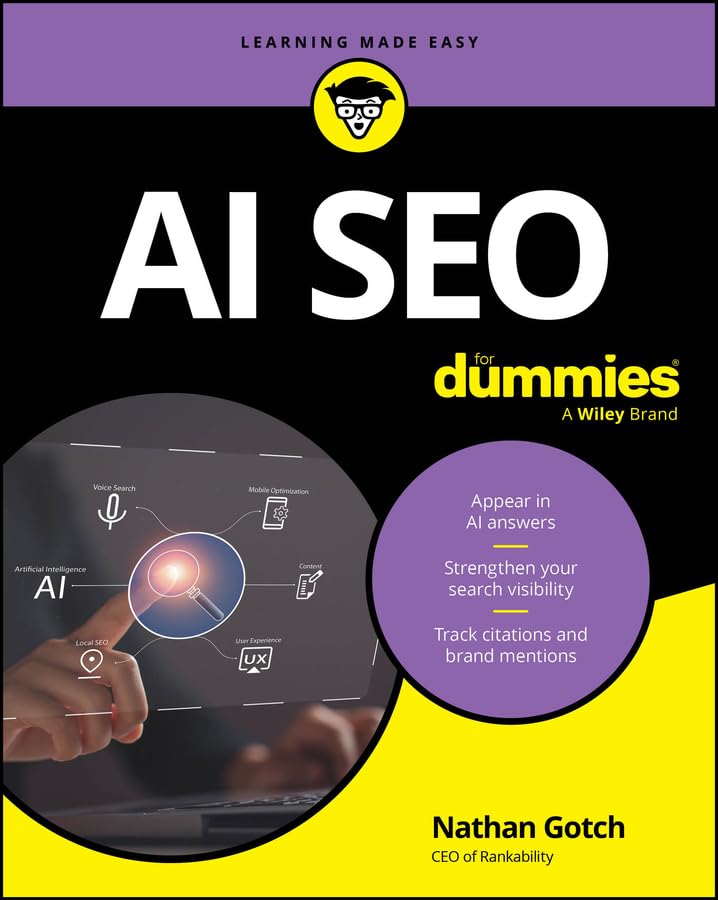
AI SEO For Dummies by Nathan Gotch is packed with useful SEO and GEO info, covering content, technical aspects, measurement, establishing authority, reputation management, earning links, mentions, and citations, and more. Many parts are repetitive; it’s as if the book were written as a reference book rather than intended to be read cover to cover. Much of it is more technical than a non-technical businessperson can handle, but less technical than an SEO/GEO specialist or web developer can handle.
In this review, I refer to AI search optimization as "GEO" (generative engine optimization) rather than as "AI SEO" as this book does.
My rating: 4 of 5 stars
Below are my notes from the book.
Note: This page contains affiliate links. As an Amazon Associate, I earn from qualifying purchases. Please see Affiliate Disclosure.
Introducing AI SEO
Traditional SEO provides foundation for search engine visibility and AI visibility
- Technical SEO: Make site easy for search engines and AI to access, understand, use
- Create content that explains what you know, what you offer, how you solve problems
- Build trust via links, reviews, mentions, citations, other authority signals
Layers GEO adds to traditional SEO
- Retrieval readiness: Make most important pages and passages easy for AI to find, parse, cite
- Entity clarity: Info about brand, products, people, locations, categories needs to be consistent across site and Web
- Answer visibility: Track whether AI mentions you when answering questions
- Off-site consensus: Info about your business on other websites must match story on your website
- Responsible publishing: Verify claims, get permission when needed, use screenshots and reviews responsibly, review AI-generated content
Signals for AI to include your brand in answers
- Discoverability: Can AI find your important pages, profiles, reviews, proof assets?
- Clarity: Can AI understand who you are, what you offer, who you serve, what makes you different?
- Consistency: Do your website, profiles, reviews, mentions repeat same core facts?
- Credibility: Do trusted sources, customers, experts, data support your claims?
- Freshness: Is your info current?
To check GEO, choose 10-20 prompts that match how customers make decisions. Include “best,” “top,” “near me,” “alternatives,” “versus,” “pricing,” “review,” “for [audience]” prompts when relevant. For each prompt, record this info:
- AI platform tested
- Exact prompt
- Date
- Whether brand appeared in answer
- Where brand appeared in answer
- Whether website or third-party source was cited
- Whether answer was accurate, positive, neutral, wrong
Ensure source-of-truth pages (Home, About, Contact, pricing, product/service pages, FAQ, policies, proof, any page that answers decision-stage question) answer these questions
- Who are you?
- What do you offer?
- Who is it for?
- Where do you operate?
- How much does it cost, or how does pricing work?
- What proof supports your claims?
- What happens next after someone buys or contacts you?
Add to important pages
- Direct answer near top
- Clear headings that match actual questions
- Short passages that can stand on their own
- Comparison tables in places where choices matter
- FAQs in places where objections arise
- Specific proof, examples, screenshots, data, reviews, etc.
- Internal links to pages that explain next question
Build off-site consensus
- Google Business Profile, local directories (for local biz)
- LinkedIn, Crunchbase, social profiles, founder bios
- Review platforms (Clutch, Trustpilot, Yelp, etc.)
- Listicles, "alternatives" pages, podcasts, press mentions, partner pages
- Places your buyers ask questions, compare options
Metrics
- Coverage: Does brand appear for prompts that matter?
- Prominence: When brand appears, how prominent is it?
- Share of voice: How much of answer space do you occupy compared to competitors?
- Citation quality: Which sources are used to support answer?
- Accuracy, sentiment: Is answer correct, favorable?
Don't focus only on rankings and traffic, but on coverage, position, share of voice, citations, accuracy, sentiment, business outcomes.
Understanding How Search Works Now
Good content structure helps for SEO and GEO (clean HTML, title tags, meta descriptions, heading tags, FAQ sections).
Website levers
- Content (brand & fact hubs)
- Commercial pages
- Content based on your experience
- Technical SEO (clean HTML, speed, mobile-friendliness, navigation, internal linking)
Offsite levers
- SERP domination: Getting brand to appear in several page 1 results for same query, via content on 3rd-party sites.
- Reviews, reputation
- Mentions, citations, links on 3rd-party sites
- Profile consistency across platforms
Undertaking Your First 30 Days with AI SEO
Verify & strengthen entity
- Ensure About page, Contact page, Organization or Person schema have accurate name, description, logo, key URLs
- Ensure 3rd-party profiles are consistent in name, role, website URL
- Ensure website uses sameAs property in Organization or Person schema to point to profile
Near top of main pages, add short Facts section that includes company name, description of what you do and where, key differentiators. Add 2-3-sentence summary that's complete answer to main question behind page.
Bottom of funnel (BoF) asset
- "Best for [Use Case]" page that explains when your solution is right fit
- "Alternatives to [Competitor]" page that positions your offer and compares options
- Use structured data
- Include simple comparisons, reference third-party reviews
- Link to this page from homepage, product pages, relevant blog posts
Talk Like an AI SEO Pro
AEO focuses on earning visibility in answer experiences (mentions, recommendations, citations). GEO focuses on helping genAI systems understand and repeat your info accurately.
There’s no solid proof that LLMs assign special value to schema, but it helps search engines understand and feature your content, and helps AI systems identify and retrieve important info from your site.
A page’s overall quality, authority, relevance help AI choose to retrieve the page. AI usually splits long pages into passages, selects passages that look relevant, and considers those passages within context window to form answer.
Write strong passage
- One main idea per paragraph: answer specific question
- Short, direct sentences: Put main claim in 1st line, add 1-2 supporting details
- Specific brand and product names, not vague pronouns
- Tight links between claims and evidence: Put numbers, examples, case studies close to statement they support
- Simple formats: Bullet points or shortlists for “top tools,” “steps,” “features”
- Use schema to reinforce structure, but visible text must stand on its own
Fact hub
- Identify recurring facts, numbers, definitions across content.
- Publish single, well-organized page that lists facts.
- Include source, date, update history for numbers.
- Use simple structure (e.g., tables, headings), and add schema.
Build consensus
- Use consistent terminology and data across site.
- Publish facts in places others can reference (e.g., blog posts, reports, studies).
- Encourage partners, customers, media to cite or link to facts.
- Update old content to match fact hub.
Track facts
- Citation rate: Percentage of AI answers that mention brand
- Fact coverage: Number of key facts that appear on reputable sites
- Fact “freshness”: Average age of data in fact hub and related content
Tracking the Metrics That Matter
Metrics
- Coverage: Whether brand shows up in answer
- Position: Where brand appears relative to competitors
- Share of voice (SoV): Combination of coverage and position that tells how much "space" you own among brands in answer
See what industry sources include competitors but not you, and work to appear in them.
Setting Up Your AI SEO Dashboard
Some AI platforms don't pass referral data, so Google Analytics only shows portion of AI-influenced traffic.
Create custom channel group in Google Analytics for AI traffic
- Dimension: Session source
- Match type: Matches regex
- Value: ^(?:www\.)?(?:chatgpt\.com|chat\.openai\.com|claude\.ai|perplexity\.ai|gemini\.google\.com|bard\.google\.com|copilot\.microsoft\.com|poe\.com|you\.com|character\.ai|meta\.ai|chat\.mistral\.ai|huggingface\.co|replika\.ai|chat\.deepseek\.com|grok\.com|openrouter\.ai|together\.ai|cohere\.com|groq\.com|janitor\.ai|crushon\.ai|cursor\.sh|codeium\.com|ai\.google\.dev|spicychat\.ai|talkie-ai\.com)$
Using Competitive Intelligence for AI SEO
When competitors beat you in answers, open cited pages, find 2-3 sentences that might be lifted into a recommendation. Update your key pages to include better passages.
Include proof near main offer, near the top of important pages (testimonials, logos, ratings, case studies, etc.).
Building Your Topic Game Plan
Problem Aware content
- Diagnostic guide (can link to how-to-fix page)
- Common-causes explainer (article that introduces solution categories)
- Checklist that help users identify problem
- Link these pages to Solution Aware and Product Aware pages
Solution Aware content
- “Best/top” lists
- Use-case pages (e.g., “for agencies”)
- Pricing pages
- Buyer guides that compare approaches, not just products
Product Aware content
- Comparisons (A vs. B)
- Alternatives pages
- “Best for X” pages that explain fit
Most Aware pages (stage when users know you, want specifics before they buy)
- Clear pricing pages
- FAQ pages
- Proof pages (case studies, testimonials)
- How-it-works onboarding pages
Info to mine for content ideas
- Sales call questions, objections
- Cancelation reasons
- Onboarding struggles
- Comparisons with competitors
People Also Ask
- Open incognito/private window
- Google pillar (main commercial) keyword
- Scroll to People Also Ask
- Expand 6–10 questions
- Copy questions into keyword template
- Repeat for close variants (e.g., “best,” “cost,” “versus,” “alternatives”)
- Use these questions in H2s on pillar page, FAQ blocks, supporting pages. If question can be answered in 3–6 paragraphs, make it section on existing page. If it needs full explanation, examples, steps, proof, make it separate page.
Page-type guides
- Pricing/cost/quote: Pricing page, cost guide
- Best/top/reviews: Listicle, buyer guide
- Versus/alternatives: Comparison, alternatives pages
- Near me/city: Local landing page
- How-to/steps: Implementation guide, SOP page
- Is it worth it?/does it work?: Proof page, FAQ, decision page
Funnel content
- Bottom of funnel (BoF): Pricing, cost, hire, demo, trial, near me, quote, best, reviews, versus, alternatives
- Middle of funnel (MoF): How to choose, what’s best for, tools for, services for
- Top of funnel (ToF): Definitions, broad how-to, general education
- Build strategy around BoF, then fill in what supports those pages.
One topic should have one primary page unless intent clearly differs.
Strong cluster
- Pillar page to win commercial term
- Support pages that capture adjacent intent (pricing, versus, alternatives, best-for, proof, FAQ)
- Internal linking so buyers and bots understand full decision
Use support pages mapped to intent, not random blog posts.
Pillar page must answer, “If I choose a solution, why should I choose you, and what do I need to know to decide?”
Pillar page content
- Promise, positioning: Who it’s for, problem it solves, outcome to expect.
- Fast path to conversion: Call, form, quote request, demo, trial, consult, or “see pricing” or “compare options.”
- Why choose you: What they’ll receive, how to evaluate options, pricing, what to expect (timeline, first steps, success metrics).
- Proof and trust signals: Reviews, testimonials, case studies, outcomes, credentials, standards, certifications, or guarantees, etc.
- Internal links to pages that answer high-intent questions (see below).
Supporting page content
- Cost, pricing: “how much,” “pricing,” “cost”
- Shortlists: “best,” “top,” “reviews”
- Comparisons: “versus,” “compare,” “X versus Y”
- Alternatives: “alternatives,” “best alternative to …”
- Variants: locations, industries, use-cases
- FAQs, objections: “is it worth it,” “does it work,” “how long,” “what’s included”
Establishing Foundations That Bots (and Models) Love
Use server-side rendering (SSR) whenever possible. If you must use client-side rendering (CSR), treat initial HTML like minimum viable page. Ensure it contains H1, direct answer near top, key body copy, internal links.
Retrieval-friendly passage pattern
- “[Entity] is [category] that [does what].”
- “It’s best for [audience/use case] when [condition].”
- “The key differentiator is [proof/metric/example].”
Creating Bottom of Funnel Pages That Win Answers
Publish pricing. If you don't, people and machines will guess, which rarely helps you. At least publish range or starting-at price.
Making Images, Video, and Data Work for You
Add captions to images
- Explain main takeaway
- Tell user what content to notice
- Connect image to point of page
- Add context that isn’t obvious from image
If video supports education, conversion, visibility, include transcript. Use edited transcript unless raw transcript is needed (e.g., webinars, interviews, compliance-sensitive explanations, any asset requiring exact wording).
Use schema to describe function of content (image, video, FAQ, article, etc.).
Ten Creative AI SEO Techniques
FAQs work best when they appear where questions naturally arise. Sprinkle them across site.
You can buy AI SEO For Dummies by Nathan Gotch as an ebook or book on Amazon.
Need Help with AI Search Optimization
Do you need to get your brand to appear in AI search, so you can get leads from people asking AI about products and services you offer? Contact us about AI search optimization (GEO/AEO).