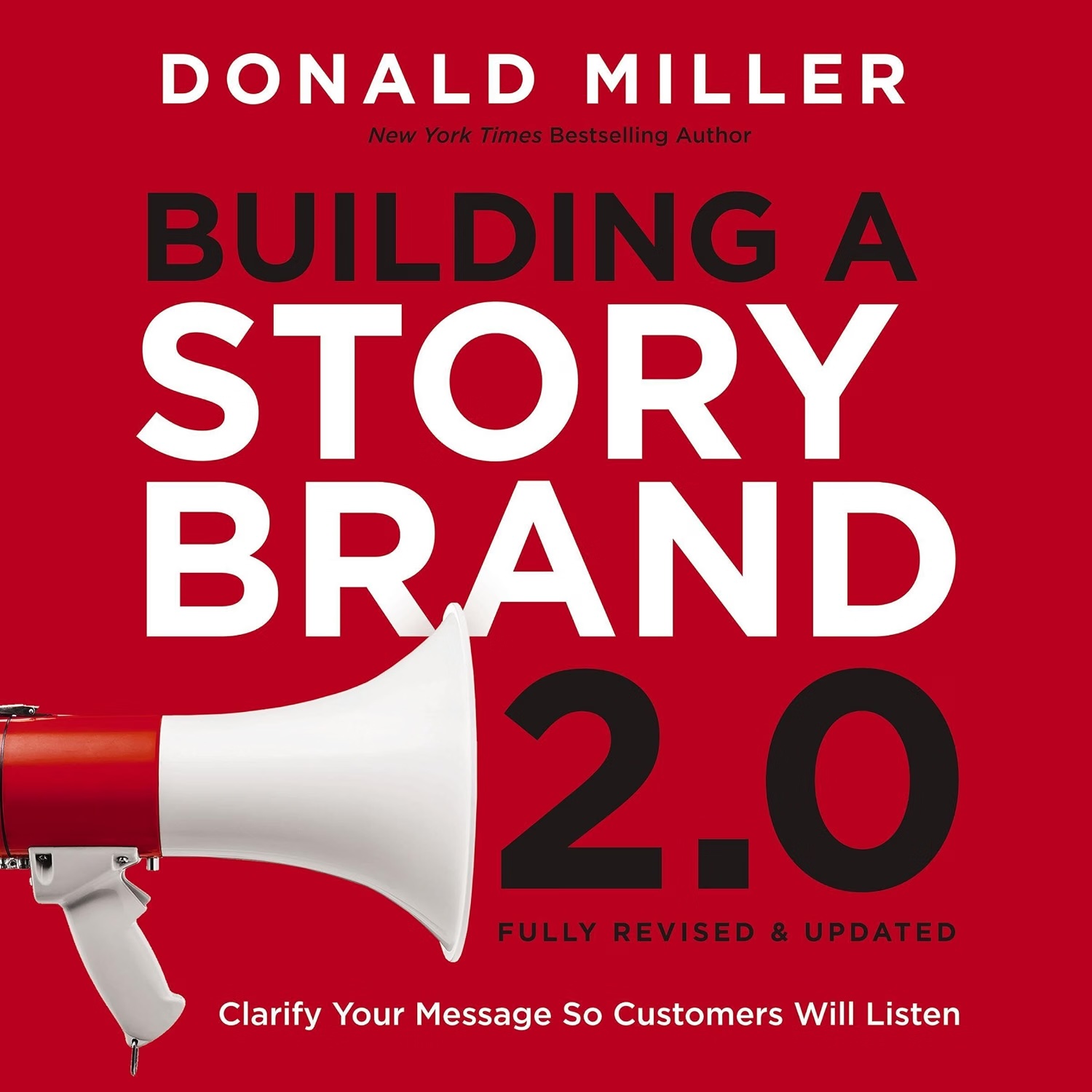
Building a StoryBrand 2.0: Clarify Your Message So Customers Will Listen by Donald Miller is one of the best branding, messaging, and marketing books I've read. Miller shows how to use storytelling to make your messaging and branding simpler and more effective. I like the straightforward, common-sense approach.
Here's the basic story framework you can customize to write your "brand script": A character who wants something encounters a problem before they can get it. At the peak of despair, a guide steps into their lives, gives them a plan, and calls them to action. That action helps them avoid failure and end in success.
This book tells how to present yourself to the customer as a guide who has a plan to solve their problem.
I didn't notice a huge difference in content from the 1st edition to the 2nd (2.0) edition.
My rating: 4 of 5 stars
Below are my notes from the book.
Note: This page contains affiliate links. As an Amazon Associate, I earn from qualifying purchases. Please see Affiliate Disclosure.
StoryBrand.ai asks questions then generates StoryBrand messaging and marketing campaign.
Businesses that invite their customers into a story are remembered. Others are forgotten.
Most marketing doesn't work because it's too complicated. Using stories in marketing makes communication simpler and more predictable.
Focus on aspects of your offer that will help customers survive and thrive. All great stories are about survival (physical, emotional, spiritual). Position products as aid to helping people survive, thrive, be accepted, find love, achieve aspirational identity, bond with tribe that will defend them physically and socially.
Don't make people think too hard to understand your offer. When people need to process too much seemingly unnecessary info, they tune out the source.
Identify what customer wants, what problems you help solve, and what life will look like after they engage your products.
Basic story framework: A character who wants something encounters a problem before they can get it. At their peak of despair, a guide steps into their lives, gives them a plan, and calls them to action. That action helps them avoid failure and end in success.
Customer is hero, not your brand.
Position yourself as Yoda and your audience as Luke Skywalker.
People buy solutions to problems. You must identify their problems and talk about them clearly.
Customers want a simple, clear path to solve their problem.
Ensure all calls to action (CTAs) are direct (e.g., "buy now," "schedule appointment") or transitional (take next step toward buying, e.g., "watch webinar," "download PDF"), not weak suggestions (e.g., "learn more," "get started").
If there's nothing at stake in whether a customer buys your product, there's no reason to buy. You must show cost of not doing business with you. Brands that help customers avoid something negative engage customers because they define what's at stake. Negativity becomes positivity when negativity is overcome.
Don't assume people understand how you can change their lives for better. Tell them.
Define something customer wants and become known for delivering that well.
When you fail to define something customer wants, you fail to open a "story gap," and they have no motivation to engage you; there's no question that demands resolution.
Pare down customer's ambition/desire to a single focus and aim overall brand marketing at that. Marketing of individual products can aim at subplots of that focus.
Focus must be relevant to customer's sense of survival: save money, save time, build community, gain status, accumulate resources (make money, increase productivity, decrease waste), be generous, find meaning (be part of a cause).
Position products as weapons customers can use to defeat a villain. Villain should be personified. E.g. time management software stops time thieves (distractions) in their tracks, because distractions dilute potential, wreck family, steal sanity, cost time and money.
In story, villain initiates external problem that causes character to experience internal problem that's philosophically wrong. Customers want to solve 3 levels of problems.
External problems are barriers between customer and stability.
People don't buy solutions to external problems, but to internal problems (e.g., feeling frustrated, incompetent, confused, helpless, hopeless, tired, overwhelmed, intimidated, embarrassed).
Frame your product as solution to external and internal problems to increase value/price.
Help customers solve philosophical problem by offering involvement in larger cause or meaning. Position products as tools customers can use to fight back against something that shouldn't be.
Frame buying your product as resolution to external, internal, and philosophical problem. E.g., Edward Jones: Villain: financial firms that don't listen to customers. External: I need investment help. Internal: I'm confused about how to do this. Philosophical: If I'm going to invest, I need an advisor who will thoughtfully explain things in person.
Customers aren't looking for another hero. They're looking for a guide.
Guide must have empathy and authority.
Show empathy because everyone wants to be seen, heard, understood. Say, "We understand how it feels …" "Nobody should have to experience …" "Like you, we're frustrated by …" "We care …"
Express empathy by highlighting common interests and values.
To demonstrate competence without making yourself the hero, tell only the parts of your story that show your care for customer and competency to help.
Customers trust a guide who has a plan.
When selling, give 3-step plan so customer knows next steps, then ask for sale.
Give each plan title (e.g., call process plan "easy installation plan" or "world's best night's sleep plan" and agreement plan "customer satisfaction agreement" or "quality guarantee").
When closing sale, say, "If you're struggling with X, which it sounds like you are, I think buying Y is the right decision. I can take your order now and you won't need to struggle with X anymore. Would you like to order right now?"
Make primary CTA button (e.g., "Buy Now," "Add to Cart," "Schedule Call") prominent in header, above fold, and as user scrolls down pages.
You must believe in your product. If you don't clearly ask for sale, prospect senses weakness; they think you're asking for charity rather than to change their lives.
Include direct CTAs (e.g., "buy now," "call today," "schedule appointment") at end of all marketing material.
Ask yourself, "What can be won or lost in customers' lives if they do or don't purchase our products?"
People are 2-3x more motivated to avoid loss than achieve gain.
Use moderate levels of fear; people don't act on low levels, and block out high levels.
Describe cost of not doing business with you (e.g., lose money, health risks, opportunity costs, make or save more with you than with competitor, declining quality of life). E.g., for financial advisor: confusion about how money is invested, not being ready for retirement, lack of transparency from advisor, lack of 1-on-1 interaction, hidden fees. "Don't postpone your retirement. You've worked too hard for too long to not enjoy time with your grandchildren."
Vision you paint for prospects should be specific and clear.
Show people happily engaging with your product.
Figure out how customer's life will look externally after their problem is solved, then how that resolution will make them feel, then how that resolution will make world more just place to live.
Single greatest motivator: desire to transform into better version of self.
Companies that assist in identity transformation often create passionate brand evangelists.
E.g., Dave Ramsey. External problems: consumer debt and financial illiteracy. Internal problems: confusion and hopelessness. Philosophical problem: moral question of accruing debt over things we don't need. Identity transformation: personal strength through strategy and commitment.
"Controlling idea" is the 1 idea you want audience to remember most; the point you're trying to make with your marketing.
Repeat controlling idea so much audience memorizes it. Use it on website header and in each section of website, in title or subtitle of lead generator, in drip emails, etc.
Landing page should pique curiosity, enlighten visitor, challenge them to commit.
You can buy Building a StoryBrand 2.0: Clarify Your Message So Customers Will Listen by Donald Miller as an ebook, book, or audiobook on Amazon.