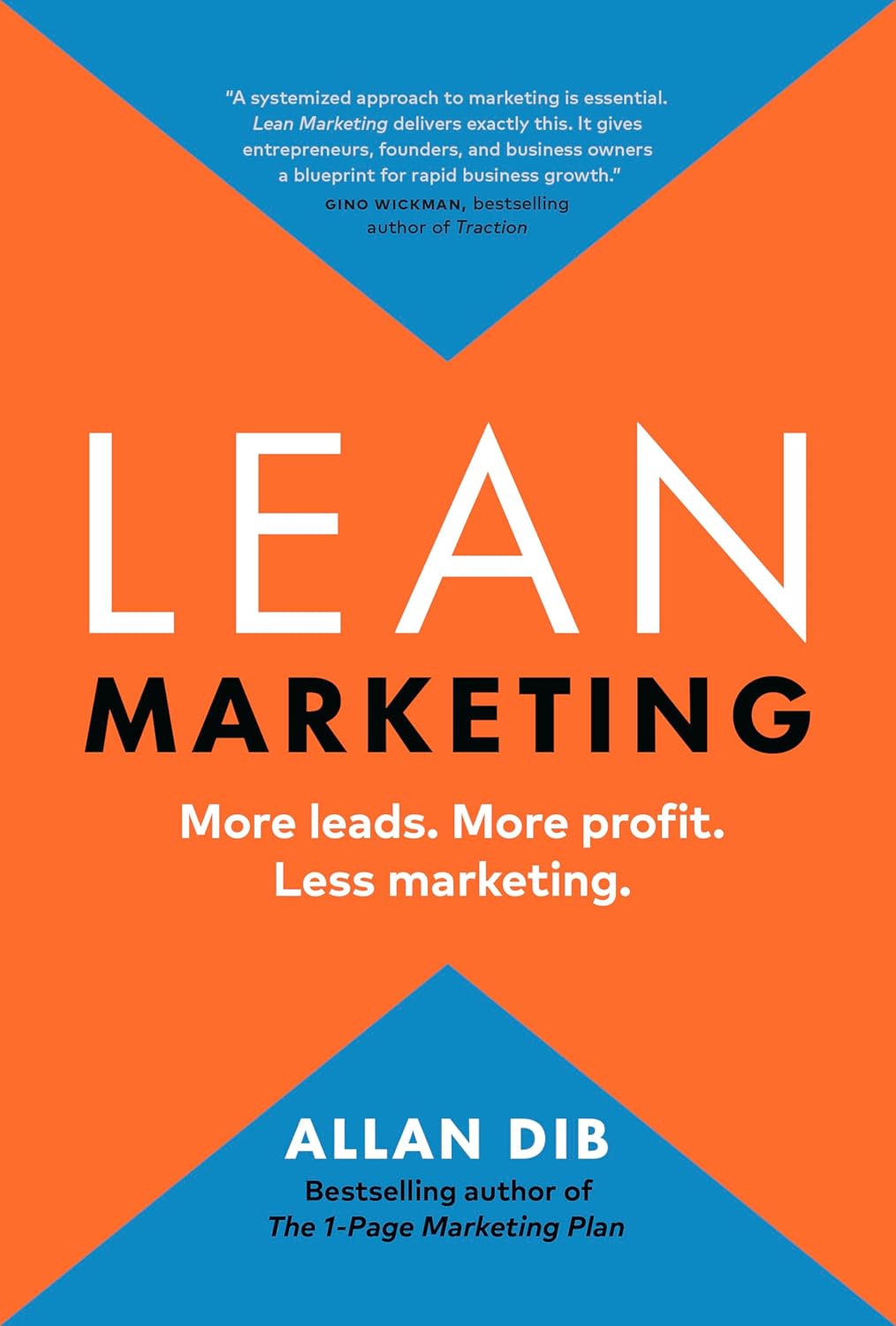
Lean Marketing: More leads. More profit. Less marketing. by Allan Dib gives insightful, strategic marketing advice. "Lean marketing" refers to a marketing approach that's about doing less and being more intentional and focused to make a greater impact. The book is much broader than marketing strategies and tactics; it also covers branding, naming businesses/products/services, hiring, productivity, customer satisfaction, and more. Each chapter ends with action items.
The book's resources are available by completing a free form.
Dib says his previous book The 1-Page Marketing Plan is strategic, and this book is tactical.
My rating: 4 of 5 stars
Below are my notes from the book.
Note: This page contains affiliate links. As an Amazon Associate, I earn from qualifying purchases. Please see Affiliate Disclosure.
Most small and midsize businesses don't have resources for mass marketing, so they need lean marketing.
"Specificity sells, generality repels." Ensure your products/services target a specific pain point so your audience says, "That's for me."
You don't need to be the best; you can differentiate by "talent stacking": being at the unique intersection of multiple talents that enhance each other.
"You are most powerfully positioned to serve the person you once were." You'll have an advantage with a target market with which you have firsthand experience with their struggles.
Find the market that perceives your product/service as painkiller, not vitamin. Pain motivates more than pleasure.
Decreasing time, effort, risk, side effects increases value prop. Increasing them decreases value prop.
"People don't have short attention spans, they have short boredom spans. … If you keep your audience engaged, they will pay attention."
Think of your content as infotainment; it must entertain as well as inform, motivate, etc. It doesn't have to be funny, but it must be compelling.
When creating content, start with emotion you want audience to feel. Tap into one or more of 7 things people really buy or sell (see above).
"Financial success fuels passion far more often than the reverse."
You don't find your passion. It finds you. As you try new things, follow your curiosity, and discover your aptitude, you create a larger surface area for passion to develop.
When you put time into something, you tend to get better at it, giving you the chance to become great at it. Once you're great at something, you're likely to develop passion for it.
Flagship asset is often content, experience, or tool.
Flagship asset demonstrates you can help your ideal prospect, highlights your uniqueness, causes prospects to identify themselves, builds trust.
For service-based business, flagship content is often DIY version of what you do, or tool that helps target market move toward solution to problem. Genuine prospects will almost always prefer to pay you to do it for or with them.
Flagship content ideas: non-fiction book, how-to guide, awards or leaderboards, white papers, case studies, research reports, structured data reports
Flagship experience ideas: trial or sample, sporting events, keynotes, parade, fashion show
Flagship tool ideas: self-assessments, scorecards, standalone tools that are part of larger tools
Base flagship asset on something that will make target market pay attention and think, "I want that."
"Content upgrades" offer content that complements your webpages in exchange for email opt-ins. Ideas: checklists, worksheets or templates, additional tips or strategies, exclusive interviews or case studies, video or audio version of content, discounts or coupon codes
On homepage, include social proof (awards, press, prestigious clients, reviews, testimonials).
On product/service pages, give clear next steps. If pricing is custom, give a range.
Sales pages should include headline, problem, solution, social proof, CTA.
Many people who will hesitate to call or email prefer live chat.
Look for ways to turn your knowledge, tools, IP into products. This can increase revenue as well as goodwill, referrals, demand for other products/services.
A-players are a great deal. You pay them more, but they produce much more than they cost you. … The money you save on hiring B- and C-players, you'll spend many times over on supervising, micromanaging, and motivating them.
Send marketing emails from an individual's name and company email address. Don't use generic addresses such as info@ or marketing@, and don't use noreply@.
Have each email focus on only one topic/theme.
Have each email include only one CTA.
Send marketing emails between weekly and twice daily, depending on industry, pace of industry news, relationship with audience. Less than weekly can lead to people forgetting about you or losing interest and unsubscribing or reporting as spam.
At the end of value-building nurturing emails, include a P.S. that you read and answer all replies, followed by non-salesy, polite offers (e.g., "When you're ready, here are three ways I can help you grow your business.").
There are niches at intersection of two or more archetypes.
Instead of overtly selling in your content, use your product/service as a prop that's incidental to content. Create valuable, useful, entertaining content to attract people with common interests around your product/service. You'll build a community of people who will eventually buy from you.
To make content creation easier, document what you're already doing day-to-day.
With reviews, testimonials, endorsements, aim for volume, quality, specificity.
Customers who are wary of giving a testimonial may be willing if you just ask for "feedback." Give them the choice of writing this or joining you on a video call which you record. After they give feedback, ask if they'd mind if you used it in your marketing material.
Customers who are desperate and see you as their final chance tend to be bad customers; avoid them.
Send customers frequent status updates, even if they just say "No news yet."
Create a visual roadmap of major milestones so customer always knows where they are in process.
You can buy Lean Marketing: More leads. More profit. Less marketing. by Allan Dib as an ebook, book, or audiobook on Amazon.
This book contains advice for improving your website and digital marketing. If you're looking for help turning your website into a marketing machine and bringing your target audience to it, contact us.